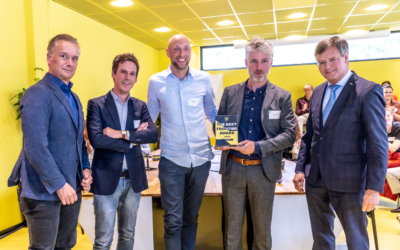
Erasmus University – Next Frontier award
Price awarded by former prime-minister Jan Peter Balkenende.
Kalpana Systems partners in SMART-CBAT to develop spatial ALD artificial interfaces that boost battery performance while reducing environmental impact.
Kalpana Systems will participate as one of the technology partners in SMART-CBAT (Sustainable Materials Research and Technology for Circular Batteries). SMART-CBAT is a project from the Dutch consortium Battery Competence Cluster-NL, funded by the Dutch National Growth Fund. The goal of the project is to develop next-generation sustainable battery solutions. Our spatial Atomic Layer Deposition (ALD) technology will be used to improve battery performance while reducing environmental impact.
Our contribution to the project focuses on developing artificial interfaces between the three essential components of advanced batteries: anodes, cathodes, and electrolytes. Using our spatial ALD technology, we can produce thin functional coatings that enhance battery performance.
The artificial interfaces created with spatial ALD address multiple performance bottlenecks. In lithium-ion batteries, this interface is crucial for the stability and performance of the battery cell. However, the formation of this interface currently costs a lot of energy and time, increasing cost and reducing capacity of the battery. Additionally, the interface typically degrades under the high voltages and currents required for fast charging. Our conformal nano-coatings create chemically inert barriers that maintain stability under these conditions. This allows batteries to charge rapidly without compromising longevity or safety. These artificial interfaces deposited with spatial ALD also reduce production time and energy consumption of the battery production process.
SMART-CBAT represents a strategic investment in European technological sovereignty. As EV adoption and the need for energy storage grow, global demand for batteries has increased significantly. The €22.3 million project aims to reduce dependency on materials and technologies sourced outside Europe while minimising the environmental footprint of battery production.
The initiative runs from 2025 through June 2028 and brings together Dutch companies and research institutions to develop advanced battery components, processes, and production equipment. These technologies focus on reducing CO₂ emissions from production and extending battery lifespan.
The project aligns with our mission to make nano coatings with high-speed spatial ALD industrially viable, offering you infinite possibilities to protect or functionalize surfaces. Until recently, atomic layer deposition was primarily confined to high-value semiconductor applications due to slow throughput. Our roll-to-roll spatial ALD system enables continuous, high-speed production, making the technology feasible for energy applications like the production of batteries and solar cells.
Within SMART-CBAT, we will work alongside consortium partners to develop scalable production processes that can be applied in commercial manufacturing. The project will generate techno-economic and sustainability analyses, creating a roadmap for bringing these technologies to market in a planned second phase.
As Europe accelerates its transition away from fossil fuels, high-performance batteries are essential infrastructure. By contributing our spatial ALD expertise to develop better battery interfaces, we’re supporting the development of batteries that charge faster, last longer, and operate more safely.
The final results of the project will be presented in June 2028.
Learn more about the SMART-CBAT project at Battery Competence Cluster-NL.
Price awarded by former prime-minister Jan Peter Balkenende.

The CAPSUL project develops copper-based solar cells using ultra-barrier spatial ALD films, reducing silver dependency and enabling lightweight, flexible solar modules.