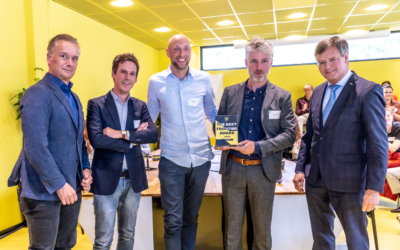
Erasmus University – Next Frontier award
Price awarded by former prime-minister Jan Peter Balkenende.
Kalpana Systems is advancing thin film technology for high-performance solar panels, supported by Rotterdam’s Smart Energy Systems programme.
On 27 February 2026, representatives from the Municipality of Rotterdam visited Kalpana Systems to see how its super spatial ALD technology can improve the performance of next-generation solar panels.
Atomic Layer Deposition (ALD) is a coating method for thin films, depositing ultra-thin coating layers, one atomic layer at a time. With our innovative super spatial ALD technology, these coatings can be produced at an industrial scale and speed, at lower costs than current methods. It opens mass-production of durable, high-performance photovoltaic cells that were previously difficult or costly to manufacture at scale.
Rotterdam is investing in the energy transition, and it sees Kalpana Systems as a key player in this effort. With support from the Smart Energy Systems (SES) programme and a direct investment from the Rotterdam Energy Transition Fund (ETF-R), we are accelerating the production of our thin-film machines. These resources help us quickly bring innovative solar solutions into real-world use, driving the city’s progress toward its renewable energy goals. In addition to financial backing, the municipality has helped us secure a suitable headquarters at M4H, one of Rotterdam’s strategic development areas.
Text continues under photo

Alderman Zeegers, responsible for economic affairs and innovation, commented during the visit: “Innovation takes time, and money. To meet our climate targets, we need to accelerate the energy transition, which is why we subsidise promising innovations. In doing so, we also strengthen the local economy. It is fantastic when we can help businesses in Rotterdam expand within our development areas, M4H and RDM. The entrepreneurs I meet radiate energy, which is exactly what we love to see in Rotterdam.”
The discussion during the visit focused on how high-performance solar panels can contribute to both the energy transition and Europe’s energy independence.
Learn more about the application of super spatial ALD for solar PV
Rotterdam leads Europe in energy innovation by turning research into scalable renewable solutions. As the city moves beyond fossil industries, it supports companies that improve renewable energy production.
During the visit, we shared our ambitions for the near future and explained our roadmap for scaling the technology from development to industrial production. In 2026, an important step in this roadmap is the upgrade of our thin-film machine for commercial deployment. This will enable manufacturers to integrate advanced coatings into solar panel production at scale.

In addition, we aim to accelerate the deployment of more efficient solar panels across Europe by expanding our collaborations with solar manufacturers and research partners.
Interested in working together? Let’s get in touch
The SES programme supports Rotterdam-based entrepreneurs focusing on the energy transition. Through a combination of subsidy funding, business advice, and access to the city’s network, the programme helps innovative companies grow and scale their solutions. We are proud to be part of this forward-looking programme and look forward to continuing its work alongside the Municipality of Rotterdam to build a cleaner, more sustainable future.
